











| |
|
|
|||||||
|
|
|
|
|||||||
|
|
|||||||||
|
|
|
|
|
|
|||||
|
|
|
|
|
|
|
|
|
|
|
Phytotoxic Properties of Soybean Oil and Emulsifiers on Miniature RosesLancaster, A.L., C.E. Sams, D.E Deyton and J.C. Cummins, Dept. of Plant and Soil Sciences, The University of Tennessee, Knoxville, TN 37901-1071.
Previous research indicated that soybean oil effectively
controlled insects and mites on ornamentals. In some conditions, emulsified
oil sprays have also been shown to cause phytotoxicity. The objective
of this research was to determine which soybean oil emulsions and/or
emulsifiers produced the least amount of phytotoxicity on miniature
roses. Greenhouse-grown 'Fashion' (pink), 'Fiesta' (fuchsia), 'Tender'
(white), 'Orange' (red), and 'Bronze' (yellow) miniature roses in
trade-gallon containers were sprayed once in late fall, 1998 . Treatments
included 1) water (control); 1% concentrations of commercial soybean
oil formulations of 2) Soygold 1000 and 3) Soygold 2000 (Ag Environmental
Products), 4) Emulsion A and 5) Emulsion B (Michigan Molecular Institute);
1% soybean oil emulsified with 6) 0.1% Ballistol (F.W. Klever, Germany),
7) 0.1% ERUCiCHEM (International Lubricants), 8) 0.1% ERUCiCHEM mixed
with 0.01% lecithin (Chem Service), 9) 0.1% soy methylester (Michigan
Molecular Institute), 10) 0.06% Atlox and 0.04% Tween (ICI Americas),
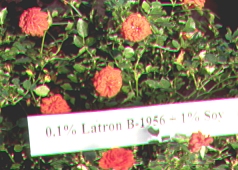
11) 0.1% E-Z-Mulse (Florida Chemical Company), or 12) 0.1% Latron
B-1956 (Rohm & Haas). |
 The
emulsifiers were also tested alone for phytotoxicity to rose foliage.
None of the emulsifiers caused significant damage. Soybean oil emulsified
with E-Z-Mulse did not cause significant phytotoxicity as indicated
by chlorosis of foliage. The commercially prepared Emulsion A, Soygold
1000 and Soygold 2000 caused slight phytotoxicity. Emulsion B and
soybean oil plus Latron B-1956 caused moderate phytotoxicity. The
soybean oil-Ballistol emulsion caused the most damage. Cultivars varied
in sensitivity (P < 0.01) to soybean oil emulsions (listed in the
order of increasing sensitivity): 'Orange', 'Fashion', 'Bronze', 'Fiesta',
and 'Tender'.
The
emulsifiers were also tested alone for phytotoxicity to rose foliage.
None of the emulsifiers caused significant damage. Soybean oil emulsified
with E-Z-Mulse did not cause significant phytotoxicity as indicated
by chlorosis of foliage. The commercially prepared Emulsion A, Soygold
1000 and Soygold 2000 caused slight phytotoxicity. Emulsion B and
soybean oil plus Latron B-1956 caused moderate phytotoxicity. The
soybean oil-Ballistol emulsion caused the most damage. Cultivars varied
in sensitivity (P < 0.01) to soybean oil emulsions (listed in the
order of increasing sensitivity): 'Orange', 'Fashion', 'Bronze', 'Fiesta',
and 'Tender'.